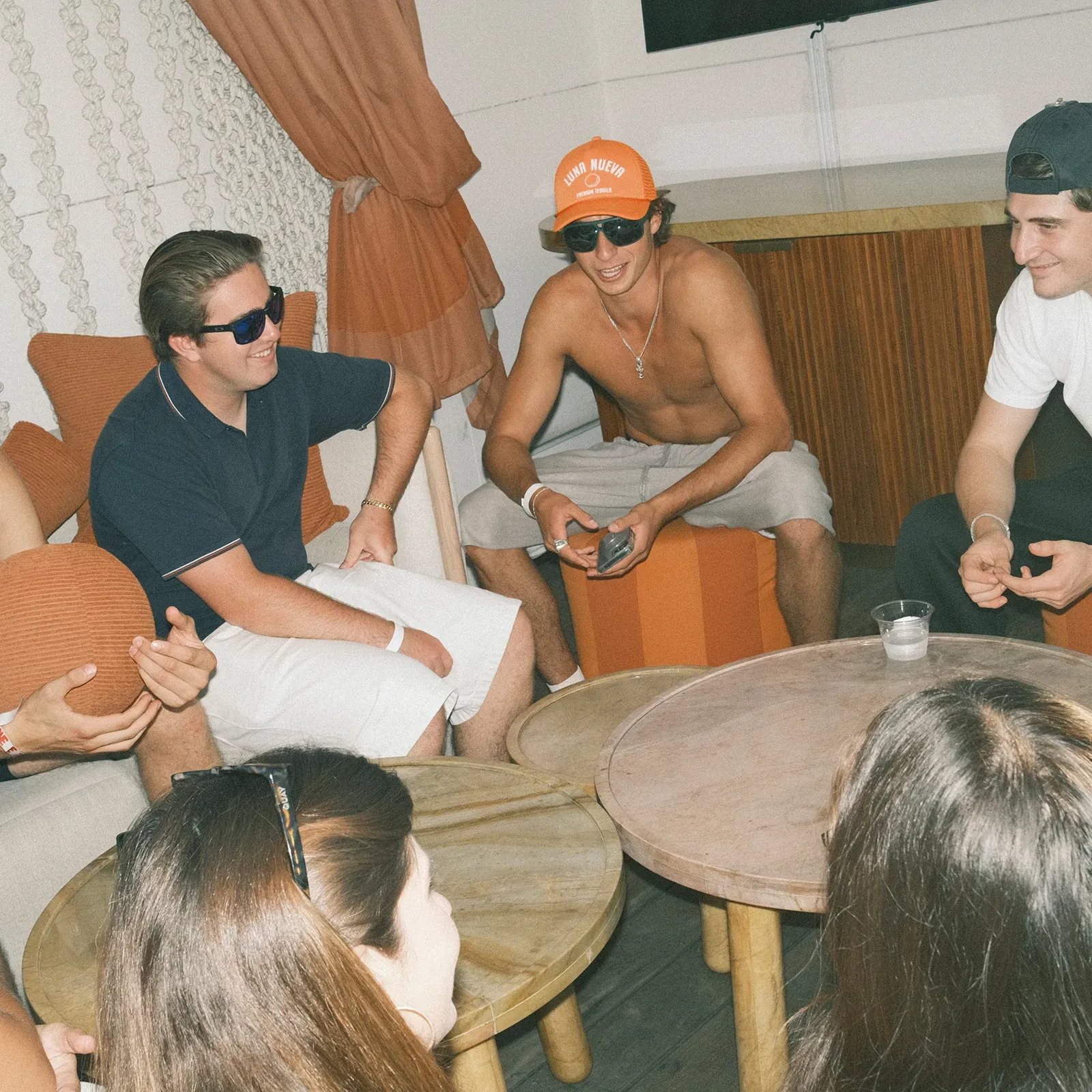
The 21-Year-Old Who Built a Million-User Party App For LA's Teen Elite
When I ask 21-year-old Jack Schwartz what he charges for a VIP table at his upcoming Manhattan party, he doesn’t answer with a number—he offers to show me instead. Reaching into his black leather jacket, he pulls out a crisp white envelope holding $27,500 in cash, stacked neatly into three separate piles, and slides it across the counter of WIRED’s New York office. On his right hand, a diamond-and-sapphire encrusted gold ring worth $10,000 glints as he moves.
Schwartz is the founder and CEO of MyPlots, a party promotion and ticketing platform he built after launching a string of wildly popular underground raves in Los Angeles starting when he was just 14 years old. He has cultivated a cult-like following since high school, teasing upcoming events on Instagram and Snapchat to stoke FOMO, then posting highlight reels to Reels and Stories after parties wrap. “We all called him The Great Gatsby,” says 19-year-old Zane Harwin, a former high school classmate of Schwartz’s who now leads marketing for MyPlots. Harwin traveled to New York with Schwartz for the upcoming party, and to pitch the app to potential investors. He’s dressed in a $500 white Chrome Hearts tee, a 424 jacket, and a clasp-less silver “permanent” bracelet he picked up at Coachella.
MyPlots launched its namesake mobile app in January 2025, originally built in large part to promote after-prom events for high school students. Today, it is the go-to event platform for under-21 partygoers across Los Angeles, boasting more than 1 million active users, and the team is now expanding its user base to include older, legal-age attendees. Daniel Herring, a 30-year-old promoter who partners with MyPlots, explains that when he first moved to LA three years ago, almost all events were promoted via rival platform Partiful. “Over the last year, though, almost everything has shifted to MyPlots,” he says.
How it works: Hosts create a free profile, build an event page, and send out invites to their network. The app lets promoters target users who have attended their past events and send text updates to guests, but it never shares guest phone numbers with promoters or third parties for off-platform use. Guests RSVP and purchase tickets directly through the app, and MyPlots takes a 20% commission on all sales. When the app launched, built-in ticketing set it apart from competitors, but rivals have caught up: Partiful announced its own in-app ticketing feature last June.
Technically, users must be 18 to create an account, but Schwartz admits “people find ways around that age requirement.” The app’s payment processor Stripe allows users as young as 13 to sign up if they have a parent registered on the account. What sets MyPlots apart isn’t its underlying technology—compared to competitors like Partiful, the app feels somewhat unpolished. Instead, its edge is the young, fashionable, connected crowd that uses it for exclusive, high-end parties, and the targeted social media marketing that draws those users in.
A scan of the app in mid-July 2026 turns up a full roster of events: an all-ages rap show at downtown LA’s iconic The Mayan nightclub; an Encino mansion party advertised as hosting “CELEBERTIES [sic]”, with a disclaimer that organizers are not liable for “anything negative that could happen” before, during, or after the event; and an 18-plus Daybreak Festival at the W Hollywood, featuring “VIP cabanas” with Schwartz’s name bolded as a headlining DJ. Ticket pricing is almost always tiered, often varying by gender, entry timing, or VIP access. A “Euphoria Mansion Party” held last spring, which listed no age restriction, expected 500+ guests and charged $75 for 30 minutes of “bedroom access”.
No longer just a teen rite of passage or a way to score clout at school, teen parties are now full-blown moneymaking enterprises for young entrepreneurs savvy enough to capitalize on the trend. Beyond MyPlots, promoters like 310 Events, Off Campus Events, and LA Social, plus ticketing apps like Plots and Turnt, all cater exclusively to young partygoing crowds. “If you get creative enough, there’s always a way to make money—even without leaving your house—if you know how to market and can navigate the internet,” says Schwartz, who counts billionaire Mark Cuban as his role model. “So many young people are on their phones all day anyway.”
Standing 5’8, Schwartz wears his dirty blond hair slicked back, with a pair of Oakleys almost always perched on top of his head. He speaks with the bullish confidence of a seasoned tech founder, with an occasional “like” that reminds listeners of his young age. He says he first became an entrepreneur at 14, as a freshman at Palisades Charter High School—locally known as Pali High—when he launched a streetwear brand called Loonar Clothing. His marketing strategy was simple: wait 8 to 12 hours outside celebrity hotspots like Boa Steakhouse and Saddle Ranch Chop House, and ask A-listers like Addison Rae to wear his t-shirts, sunglasses, and other merch on camera. The tactic landed him a feature on Inside Edition.
Just before the Covid-19 pandemic hit, Schwartz threw three back-to-back parties that built his reputation at school. “Everyone was asking, who is this Jack Schwartz kid?” he recalls. “Every kid at Pali, even the seniors, were coming.” The first was held in a rec room at his father’s apartment complex, with his dad working security and collecting payments. The next two were held on Hollywood Boulevard, where he paid $2,000 cash to rent the space. Schwartz says it was never hard to find venues willing to rent to minors. “If you go to Hollywood, some of these venues … they’ll do anything for business.”
His parties weren’t always hosted at official venues: they popped up in empty warehouses, unused offices, even friends’ family homes. “A lot of the time, the parents … wouldn’t care,” Schwartz says. “They would be upstairs, and we’d take over the backyard.” But it wasn’t always drama-free: one of his New Year’s Eve warehouse parties was shut down early after police arrived, and Schwartz claims the venue didn’t hold the correct permit.
Schwartz isn’t the only promoter who says it’s surprisingly easy for underage kids to book party venues in LA—if they have cash to spend. Matt, a 20-something venue operator who caters to brands and celebrities, started a party-promoting Instagram account as a teen. He recalls renting corporate event space and buying one-night insurance for a couple hundred bucks on sites like Eventhelper.com or Eventsured. (Neither website responded to WIRED’s request for comment.) Asked how he secured insurance as a minor, he says he “probably” put it under his dad’s name or found another work-around. (WIRED uses a pseudonym for Matt to help him avoid professional repercussions.) “Some people are desperate for money,” he says, explaining why adult owners are willing to take on the liability of working with minors.
And the liabilities are many. Matt recalls that a Brentwood dance studio he rented for a high school event hosted another teen party months later, and the floor collapsed under the weight of the crowd. Los Angeles Magazine reported at the time that the collapse sent “rowdy rich kids spilling into the streets.” As a venue operator now, Matt says he’s worked with “really kind, sweet high schoolers” and teen promoters who cut every possible corner. Some hire untrained friends as security, or sneak alcohol into venues hidden inside staging equipment. Underage guests bring their own risks: often showing up already visibly intoxicated, and becoming aggressive when they’re turned away at the door.
In 2024, Schwartz appeared in Social Studies, an FX documentary series about the highs and lows of teen social media use. According to the doc, in 2022 Schwartz co-hosted his own birthday party with a friend. A social media post for the event explicitly advised guests against bringing “visible alcohol.” Even so, the show depicted the party descending into debauchery: guests drinking out of hidden containers, smoking, casual hookups, a fight between two girls, and a teenage boy hanging off an indoor balcony railing. Guests interviewed for the doc said one attendee threw up before passing out on the ground. His friends called an ambulance, but only after dragging him a few blocks away to avoid getting the party planners in trouble. “That’s scary,” Schwartz told the documentary camera in a follow-up interview. “That’s also why we purchased insurance.”
When asked about the FX series, Schwartz says the filmmakers misrepresented him. He now claims the birthday party in question wasn’t his, he didn’t organize or manage it, and he never purchased insurance for it. FX declined to comment.
In Schwartz’s junior year, after Covid-19 lockdowns lifted, teens were desperate for in-person connection. He decided to go all in, throwing parties under the brand MyPlots—“plot” is teen slang for a plan or something to do—and advertised them on Instagram. But the process was messy, he says: people sent him money via Venmo and Zelle or paid $20 cover at the door, and sometimes security guards would pocket cash from ticket sales. “There had to be a better way to facilitate these events, make them safer, and provide people with more security,” he recalls. “So that’s why I created MyPlots.”
To grow his brand, Schwartz grew his TikTok following to 1.6 million by posting viral man-on-the-street videos asking passersby how much their outfits cost. He also landed a monetization deal with Snap’s Spotlight program for what he calls “a lot” of money, picking up hundreds of thousands of new followers in the process. (Snap did not respond to requests for comment.) In 2023, during his senior year, Schwartz used proceeds from his parties to buy a blue BMW M340i that he says cost $50,000.
Zane Harwin was a freshman at Pali when Schwartz was a junior. A former captain of the school’s surf team, Harwin is 6’4”, with a mischievous smile and wavy, beachy brown hair. He towers over his boss, but has always looked up to Schwartz. Harwin fondly recalls arriving at one of Schwartz’s massive Brentwood house parties, seeing cars lined up for blocks down the street and Schwartz dutifully running the door. “He’s the man of the party,” Harwin says, adding that his proximity to the business means some girls have offered to do “anything” to get into exclusive events. (He says he would never take them up on that.)
As a duo, they’re a modern-day Spencer Pratt and Brody Jenner: Schwartz is the brains of the operation, and Harwin is the charm. They speak with nostalgia about the chaos of their high school party days, throwing events in iconic LA neighborhoods like Beverly Hills and Bel Air—some so crowded that guests would fall into the hot tub. Lucas Ward, another Pali classmate and now MyPlots’ head of marketing, remembers seeing a kid “literally get knocked out cold” during a fight at one early party. “Kids would make it a mess, but it was authentic high school parties,” Harwin says.
MyPlots likely could not have been born anywhere but the affluent neighborhoods of West LA, where many teens have easy access to cars, envy-inducing family homes, generational wealth, and front-row access to the Pacific coast. Zillow pegs the average home price in Pacific Palisades at just over $3 million. Pali High is so iconic for its trendy student body that there was once a popular TikTok account devoted entirely to sharing students’ daily outfits. As is typical for kids in this area, both Schwartz and Harwin grew up well-off: Schwartz’s mother runs a marketing agency while his father holds a corporate job, and Harwin is the child of a TV personality/producer and a restaurateur/hospitality real estate developer. “It’s like the number one place if you want to be an influencer,” says Harwin. “Social media is the biggest here. Everyone in LA knows someone connected to Hollywood, and you post one video here, it’ll go viral.”
Rachel, a Culver City–based mother of a 17-year-old son and 15-year-old daughter, says both of her kids and their friends regularly attend ticketed parties thrown by other teens, promoted on social media; her son’s friend even runs his own “business” throwing parties at rented private homes. Teenagers in the LA area “can stay out really late and, you know, just take a Waymo and be very independent,” she says. The fact that “everyone has their parents’ credit card on their phone” is a game changer, she adds. “Kids are just kind of absent-mindedly spending a lot of money.”
Beyond lavish locations, these modern teen parties are markedly different from the casual backyard get-togethers most people grew up with. Rachel’s daughter, Amber, says parties are typically advertised on Instagram and Snapchat, and the exact location is only revealed the day of the event. Usually, girls’ tickets cost less than guys’, and kids can prepay online, then scan a barcode at the door. The hosts, many of them teens themselves, use apps like MyPlots to sell tickets. Most crucially, they’re making real money off parties that 20 years ago would have just gotten you grounded by your parents.
In May 2025—just a few months after the launch of MyPlots—Schwartz and Harwin threw an “after-prom tour,” hosting parties for seniors to attend once their school proms ended. Harwin advertised the party “tours” on Instagram, filming from exotic cars and penthouses with stunning mountain views, sometimes using stacks of cash as props. “Nobody else in the world has done a tour like this,” he said in one Reel, sitting on stone steps behind a swimming pool. Their strategy for selling tickets tapped popular high school seniors to act as brand ambassadors—a role Harwin filled when he was still a student at Pali.
As is common with large after-prom ragers, things sometimes got out of hand. Several attendees of one tour stop say event security got aggressive and shoved students. Schwartz brushes this aside, first claiming that the security came with the venue and later noting that too many students tried to sneak their friends in for free. “It was like a shit show,” he says. “The crowd was so disrespectful.”
Raine, a 16-year-old who lives in Venice, attended a backyard party in the Rancho Park neighborhood advertised on MyPlots and Instagram last March. (Rachel, Amber, and Raine are all pseudonyms, to protect their privacy.) As they were leaving, at around 10 pm, Raine saw a girl, clearly intoxicated, lying unconscious on the front yard grass. The fire department was called to the scene. The account promoting the party later posted an Instagram Story with the text: “two drunk ho** ruined the party for yall NEXT ONE GON BE CRAZY.”
Schwartz wants to distance himself from independent promoters who use his app. He says the technology simply facilitates ticket sales, that he has no connection to the majority of the parties on MyPlots, nor does he bear any legal responsibility. “I have no idea who 95 percent of [the promoters] are,” he says, adding that he’s very selective about what events he personally throws. “It’s not worth the liability to make a few thousand dollars.”
Marley Majcher, who plans high-end events in LA through her business The Party Goddess!, is skeptical that young party promoters can avoid liability, even when they purchase single-night insurance. Majcher organizes luxury events including sweet sixteens and bar and bat mitzvahs in locations like Beverly Hills and Malibu. She says her own lawyer has stressed the importance of airtight contracts to account for things like accidents and drinking and driving. “There's just no way that these people have the coverage for what they need to have … especially here, where we're very sue-happy and affluent,” says Majcher, 56, who jokes she looks much younger “due to the amount of Botox and skin treatments I have on a regular basis.”
William Lemmon, the principal broker at Broadway Insurance Services, says that a party host would generally need a special event permit, an occupancy sign-off if the space isn’t zoned for a crowd—like a warehouse or office—the fire marshal's approval, and a permit for alcohol sales, which a minor can't legally apply for. Instant online insurance works perfectly fine when everyone is an adult, but if “a teenager is charging a cover at a warehouse with booze, that's about as far from the intended use as it can get,” he says. He also points out that minors generally can't be held to contracts, so the insurance carrier could argue the policy is invalid. Liability for these events is a “pile-on” that would involve the promoter, tenant, property owner, whoever provided alcohol, and possibly parents if the party thrower is underage. “Here’s what it really comes down to: Take that same party and make everyone 21, and it’s insurable. Add minors and alcohol, and no carrier will knowingly touch it.”
For now, though, the business is thriving. Following the successful 2025 after-prom tour, Schwartz and Harwin say they took a monthslong European vacation, flying first class and visiting Amsterdam and Ibiza, among other spots. Despite Ibiza’s reputation as one of the world’s party capitals—with clubs open all night and after-hours gatherings that last the entire next day—the pair decided to throw their own event at their rental villa. “We go to this post office, we create a flyer, and we're printing out like hundreds of flyers,” Harwin recalls, detailing how they went to the massive outdoor club Ushuaïa and threw the posters into the crowd. “The next thing we know, we go back to the villa, and there's already a line.” They claim they charged $100 a head and walked away with around $10,000 in profit. When I ask why they felt the need to work during a vacation, Harwin says they missed the hustle: “This is what we do. We’re good at this.”
By early June 2026, Schwartz had transitioned to throwing parties for an 18-plus crowd—and brought his business to the East Coast. A few hours after our meeting at WIRED’s office, I head to HK Hall, a two-story nightclub in Manhattan’s Hell’s Kitchen neighborhood. Schwartz and the MyPlots team are hosting an after-party for Houston rapper Don Toliver’s Madison Square Garden show—the same event with the $27,500 table fee. It’s their second big New York
The 21-Year-Old Who Built a Million-User Party App For LA's Teen Elite