The Uncertain Future of AI Influencers, as Regulation and Platform Crackdowns Loom
For almost 20 years, Clarissa Mansbridge built a thriving career working behind the scenes of the global entertainment industry, collaborating with A-list names from pop star Jason DeRulo to Shengo Deane, Kim Kardashian’s former head of security. Preferring to stay out of the public spotlight herself, she loved the rush of her work: growing personal brands, defusing sudden crises, and problem-solving through the daily grind of celebrity management.
That all changed three years ago, when Mansbridge’s life was upended by a devastating pregnancy complication: her son was born without a heartbeat at 33 weeks gestation. Doctors successfully resuscitated him, but months in the neonatal intensive care unit brought one terrifying health scare after another, with no guarantee he would survive. When the family finally made it home in what can only be described as a medical miracle, Mansbridge—who lives in Brisbane, Australia—knew her old high-intensity work schedule could not accommodate the ongoing recovery needs her son faced.
Searching for a flexible new career path, she began experimenting with AI image generation tools, eventually creating Mia Metaverse: an influencer and model crafted to be “humbly wealthy, wholesome” for social media. A lifelong fan of early Sims games, Mansbridge fell in love with the process of building storylines and glamorous, immersive settings for her virtual creation to navigate. Now 34, Mansbridge says she earns roughly $6,000 per month from brand collaborations and designing custom AI influencers for corporate clients, most of which require her to sign non-disclosure agreements that bar her from naming them.
Yet even as this year becomes her most profitable since launching her AI venture, Mansbridge and hundreds of other AI creators share a growing fear: new global rules governing AI content on social platforms could completely upend their business model.
Since generative AI and text-to-image tools exploded into the mainstream in 2022, creators have built lucrative businesses around virtual personalities that are more affordable, scalable, and brand-safe than their human counterparts. Valued at an estimated $14.5 billion today, the virtual influencer market is projected to hit $110.4 billion by 2033, with a reported annual growth rate of 33.6%. Brands are fully on board: research from social agency Billion Dollar Boy found that 79% of marketers are increasing their investment in AI-generated creator content.
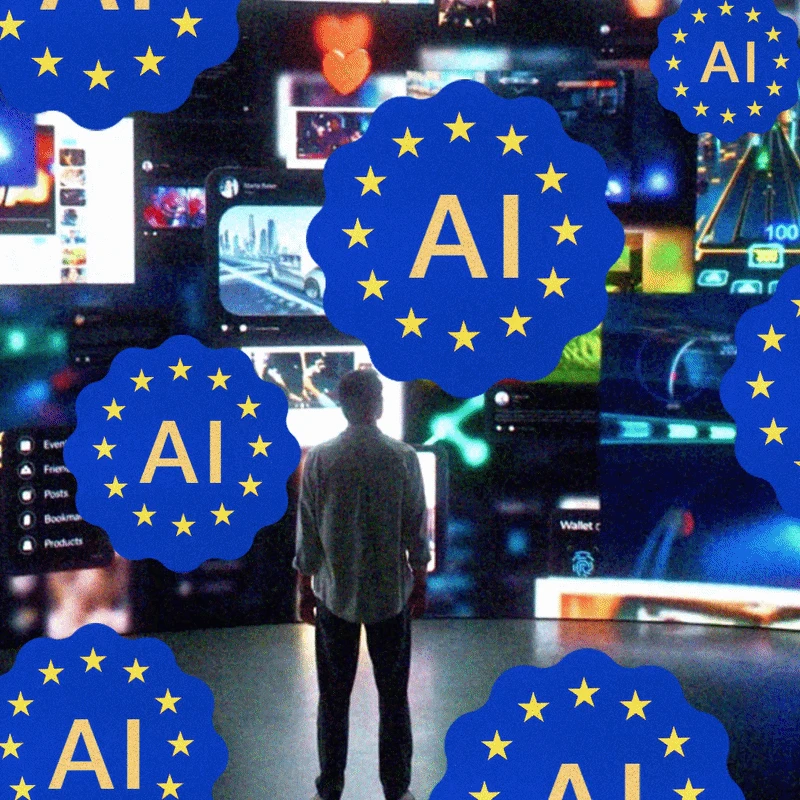
But as regulation catches up to this fast-growing new industry, the tide may be turning. Starting August 2, new rules under the EU Artificial Intelligence Act require AI-generated or manipulated promotional content to be clearly labeled, while major platforms like TikTok are tightening AI detection systems and reshaping feeds to prioritize human creators over low-quality synthetic spam. For people who rely on AI influencer work for their full-time livelihood, this leaves a confusing regulatory maze with no clear roadmap to navigate.
The EU AI Act is the first-ever comprehensive legal framework for AI—dubbed a “global first” by European Commission President Ursula von der Leyen—and was designed to foster “trustworthy AI” across the bloc. Under Article 50 of the act, providers and users of AI systems must disclose when audio, image, video, or text content has been artificially generated or edited. But the rule carves out an exception: “where the content forms part of an evidently artistic, creative, satirical, fictional, or analogous work,” transparency requirements are limited to disclosure that does not interfere with the display or enjoyment of the work. This leaves huge room for interpretation—and widespread confusion.
Kai Zenner, digital policy adviser to Member of Parliament Axel Voss, one of the lead negotiators of the act, says the legislation was drafted too early and too abstractly to fit the current AI creator ecosystem. “ChatGPT had only just come out, and there was scant knowledge among MEPs and parliamentarians about what exactly we were regulating for,” he explains. “The core driver was simply: AI is here, and more AI-generated content is coming, so let’s raise the AI literacy of EU citizens [by implementing the labeling clause].”
More regulatory changes are on the way that will only add to this uncertainty. “There are several revisions coming later this year and next that will force influencers not only to label their content, but provide transparency on where they come from, what they want to do, and how they are financed,” Zenner explains. “It’s still really unclear how that will be managed, since all we have to go on is Article 50.”
Zenner worries AI creators could get tangled in a web of overlapping rules: the AI Act, copyright law, audiovisual media regulations, consumer protection law, and possibly even the EU’s proposed Digital Fairness Act, which targets online tactics that exploit or mislead users. “People running these accounts could find one law says their content is lawful, while another law says it's unlawful,” he says.
Platforms Are Swinging at AI Content With a Sledgehammer
A 2025 industry survey found 60% of AI-assisted creators have already broken industry rules accidentally due to mislabeling, meaning the risk of missteps will only grow in 2026. Most major social media platforms have rolled out their own independent crackdowns on AI content.
In mid-July, TikTok announced a new detection system to root out AI spam, which the platform claims is “crowding out original creators.” The app already requires creators to label AI-generated content and lets users reduce the amount of AI content that appears in their feeds. Pinterest takes a similar approach, while Meta automatically adds an “AI info” label to any AI-generated content it detects across Facebook, Instagram, and Threads.
“The same platforms that once encouraged more content, produced faster and at a lower cost, are now tweaking their algorithms to push that content back down, but none of these systems are precise enough,” explains Matt Navarra, social media consultant and author of the weekly Geekout Newsletter. “The platforms are swinging at AI content with a sledgehammer when what they need is a scalpel.” He estimates even human creators will get caught in the crackdown, even if they only used AI for minor tasks like cleaning up grammar.
Some creators are already feeling the impact of algorithmic shifts. Lionel Metge, a Lyon-based hip-hop artist and producer who launched AI reggaeton/Afrobeat artist Zairo earlier this year, has already seen how platforms’ new approach to synthetic content hits his reach. He’s noticed new detection systems flag AI-generated content immediately after publication, especially when an account openly identifies itself as a digital creation.
Metge accepts that the new rules could already be limiting reach for Zairo’s 23,800-follower account and cutting it off from some of its target audience, but he believes the rules are necessary to avoid misleading the public, especially as AI generation models grow ever more realistic. “I hope in future that algorithms won’t overly restrict the reach of AI-generated content,” he tells WIRED, adding that he plans to double down on “quality and overall coherence” to keep Zairo standing out from low-effort spam.
Industry insiders note platform crackdowns are a response to a real problem. Fanvue, a platform that lets creators connect with fans and monetize their content, has been working with AI creators to roll out disclosure standards ahead of the August EU deadline. “We’re seeing creators lean into transparency as a differentiator, with some building unique content that’s only possible for an AI persona, rather than trying to conceal it,” says Rob Haywood, Fanvue’s head of safety. He notes TikTok’s crackdown comes in response to “a tide of low-effort synthetic content flooding feeds and reducing the visibility of real creatives.”
Zenner advises AI creators to get ahead of future legislation by demonstrating “good faith effort” on transparency now, a move that could help if enforcement becomes tougher or less clear down the line.
For Mansbridge, that means expanding beyond a single character to build a full portfolio of AI personas that she hopes can be cross-promoted and eventually run autonomously. “I want to create a legacy for my son, so that if ever he needs anything, it’s financially covered,” she explains. Her approach is not to hide that her personas are AI, but to build openness into her brand to make it safer for advertisers. She built Mia Metaverse to be “relatable, but aspirational,” a clean slate with no history of scandals, controversial politics, or broken morals clauses. In a market facing tougher transparency rules, that kind of predictability could become an asset: The more platforms and regulators demand disclosure, the more valuable fully controlled, open AI personas may become.
Not all AI creators see the coming clampdown as an existential threat. Wim Tilkin, a 60-year-old Belgian animator behind the popular AI-generated character PuppyBerry Mousy, takes a more measured view. He supports “clear and well-balanced regulation,” especially around copyright, but worries Europe’s tougher approach could slow innovation and deepen the region’s dependence on tech from the US and China.
His project began when he realized AI let him run a full animation studio as a one-person team. “By hand, I created a five-second clip of this super cute fluffy mouse in a scarf eating a piece of cheese, fed it into AI, and put music to it,” says Tilkin. “It got three million views so I thought: OK, I have a hook.”
Just under two years after that first video, PuppyBerry Mousy has 236,000 followers on Instagram and 683,000 followers on Facebook. Posting clips of the mouse dancing, singing, and sharing gentle encouraging mantras, Tilkin says growth has been strongest in the last five months, with most of the audience based in the US and UK, especially women over 50. He says he receives regular messages from people who are lonely or sick, telling him they found comfort in Mousy’s dancing or in something the character said. “Mousy is all about softness and coziness in a hectic world,” he explains. “I’m glad that combination is bringing people joy.”
Having lived through the industry transition from 2D to 3D animation earlier in his career, Tilkin sees the current AI moment as just another technological shift. “AI will follow a similar path,” he says. “As artists, we have more tools and possibilities to suit our creative voice than ever before, but more choices to make.” For him, the critical question is whether regulation can protect, rather than flatten, the kind of storytelling and emotional connection that drew audiences to Mousy in the first place.
The Uncertain Future of AI Influencers, as Regulation and Platform Crackdowns Loom