China Claims Title of World’s Fastest Supercomputer, Overtaking the US
China has reclaimed the top spot as home to the world’s fastest supercomputer after nearly a decade, ending the United States’ recent reign atop global supercomputing rankings.
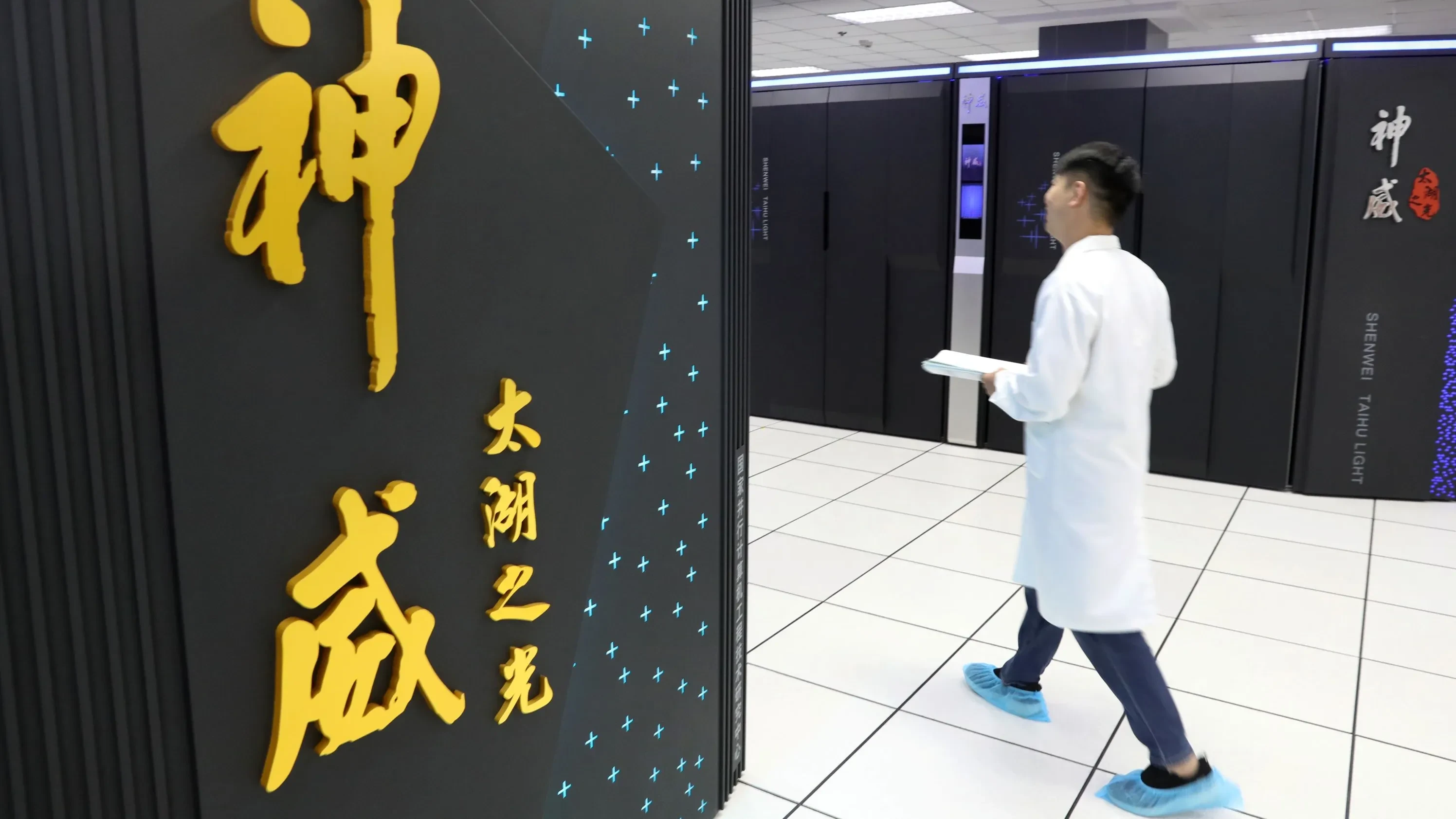
The new leading system, named LineShine, is hosted at the National Supercomputing Center in Shenzhen. It pushed the US supercomputer El Capitan out of first place in the biannual TOP500 ranking, which ranks systems by overall computational power.
This landmark breakthrough arrives amid an increasingly fierce race for technological supremacy between Beijing and Washington, a rivalry that has played out through steep reciprocal tariffs and sweeping restrictions on a wide range of advanced hardware components and software.
First launched in 1993, the TOP500 ranking evaluates the world’s most powerful supercomputers every six months using a suite of standardized performance benchmarks. The assessment accounts for each system’s theoretical maximum speed, real-world operational performance, and energy efficiency to produce its final rankings. For most of the list’s history, US-developed systems have dominated the top spots. LineShine’s ascent returns China to first place after it spent almost a decade out of the top ranking.
El Capitan, located at Lawrence Livermore National Laboratory in Livermore, California, had held the number one position since 2024. New official benchmark results confirm that LineShine outpaces the US system’s total processing capacity by more than 20 percent.
Drawing approximately 42.2 megawatts of power, the Chinese supercomputer delivers a peak performance of 2,198 exaflops — a metric that means it can complete more than 2 quintillion individual operations every single second.
One of LineShine’s most unusual and notable features is that unlike most cutting-edge next-generation supercomputers, it does not rely on graphics processing units (GPUs) for heavy computational work. Instead, it runs exclusively on central processing units (CPUs), the common processing components found in everyday devices from smartphones to desktop and laptop computers, which are rarely used to power large-scale scientific computing systems.
An even more significant defining feature is that LineShine’s entire end-to-end infrastructure is built with fully China-developed hardware and software.
LineShine’s architecture is built around China’s domestic LingKun platform, and is made up of roughly 45,000 custom LX2 processors. Each LX2 chip features 304 processing cores and operates at a 1.55 GHz clock speed. The system’s individual processing nodes are connected via the homegrown LingQi high-speed network, which was designed specifically to minimize latency and speed up inter-node data exchange. The entire supercomputer runs on Kylin OS, a Linux-based operating system that is already the standard for China’s scientific research and government computing infrastructure.
A Clear Message From China to the US
China’s return to the top of the TOP500 rankings is widely interpreted as an achievement that extends far beyond simply claiming the title of world’s fastest supercomputer. Beijing has made it a priority to demonstrate to the global community that its domestic tech industry can thrive and compete at the highest level even when cut off from access to key US-developed technologies.
Starting during Donald Trump’s first presidential term and continuing throughout Joe Biden’s presidency, the United States implemented strict export controls on advanced computing-related components, software, and development platforms, with the explicit goal of slowing China’s technological progress. In response, Beijing enacted its own reciprocal restrictions on US tech.
These restrictions have grown even tighter during Trump’s current second administration, particularly through expanded tariffs and new limits on imports of GPUs, advanced semiconductors, and other core components tied to artificial intelligence (AI) — a technology that underpins a large share of the world’s most powerful modern supercomputers.
These US-led restrictions have forced China to invest heavily in developing fully domestic new architectures and technologies, enabling the country to build high-performance supercomputers that can outpace top-tier US systems even without access to cutting-edge imported resources.
This article was adapted from original reporting published in WIRED en Español, originally released in Spanish and translated for this edition.
China Claims Title of World’s Fastest Supercomputer, Overtaking the US